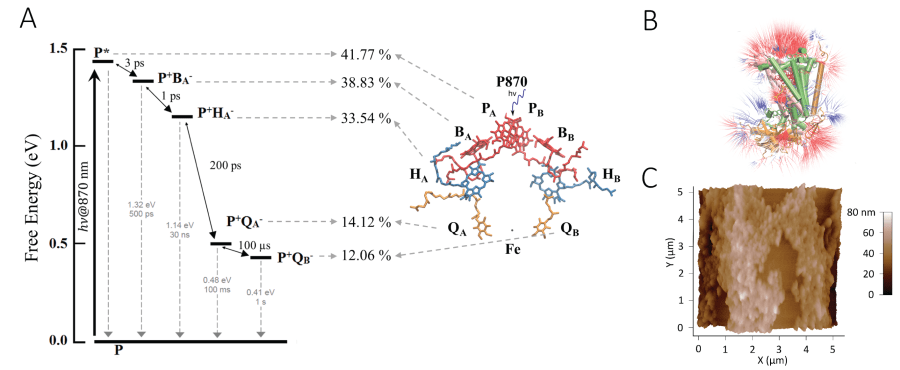
We receive peak power of 1-1.3 kW/m2 from the sun on a sunny day. It is very desirable to harvest this light, store it, and use it during low light conditions. There are many different designs for solar cells. In this project, we tried to adopt nature’s solution for harvesting light for solar cell application. The project focus was on the design and fabrication of different architectures for utilizing reaction center of Rhodobacter sphaeroides in a solar cell device (Figure A, B). I proposed using electrospraying of RCs on HOPG for fabrication of photo-active electrodes (Figure C). In collaboration with two postdocs and three PhD students at UBC, we could show that the RCs not only survive the electrospray process but also yield peak photocurrent densities that were the highest value reported to the date of publication.
Publications on this topic:
- Photoactive Electrodes Incorporating Electrosprayed Bacterial Reaction Centers (Advanced Functional Materials)
- Photocurrent generation by direct electron transfer using photosynthetic reaction centres (Smart Materials and Structures)